

Remembering a friend and giant whose unwavering resolve carried the Oromo cause beyond borders, Seenaa Jimjimo.

Condolence Call
A dear friend called me and said, “I am so sorry, I just saw your post about Professor Hamedessa Tuso.” I replied, “Yes, my heart breaks. I feel so bad that I hadn’t reached out to him more often. I was too busy with my own struggles and completely forgot. I wish I had checked on him as I promised.”
A Towering Mind
Professor Hamedessa was not just an intellectual, he was a force of nature. One of the few towering Oromo minds with whom I had deep and meaningful conversations, even when we disagreed. He was fierce, uncompromising, and unshakable in his convictions.
“You see,” I told my friend, “he was hardcore anti-Ethiopia and distrusted any Ethiopian leaders who claimed to care about Oromo. He was a man of principle. Through our conversations, it became clear I was not going to change him, even as my own views on Oromo struggle politics evolved.”
Conversations That Shaped Me
I recall many of our conversations, one in 2022 about the release of prominent Oromo political prisoners, and another in late 2023 following the dialogue between OLA and Abiy. Despite his deep distrust of Ethiopian leaders, he believed that if there was any hope for genuine peace and reconciliation between the Oromo and what he called the Ethiopian empire, including the current so-called Oromo leaders, it would have to come through indigenous reconciliation, which he saw as the only lasting solution. I say “so-called” because there was ongoing debate about Abiy’s true identity, and Professor Hamedessa shared similar views.
Why I Write This
As my heart ached, my friend said, “You must say something.” He insisted. So, I went back to our many emails over the years. While our conversations were numerous, one stood out, one I suspect few know about.
Before I share that, I must say his passing is not only a loss for his family and those who knew him, but for the entire Oromo nation. Even as age and health made him frail, and despite the shifting Ethiopian political landscape, he remained strong as steel in his Oromummaa. His spirit never bent. His love for his people never wavered, even when dark clouds of confusion loomed over many.
A Reflection on Life
On a personal level, his passing reminded me how fragile life is—that tomorrow it will be our turn, and the next generation will wonder who we were and what we did in our time. There is no way I can fully describe his contribution to the Oromo struggle, but I will share one story that stood out to me. This message is my tribute to him, the man and legend I had the honor of knowing.
The Story That Stood Out
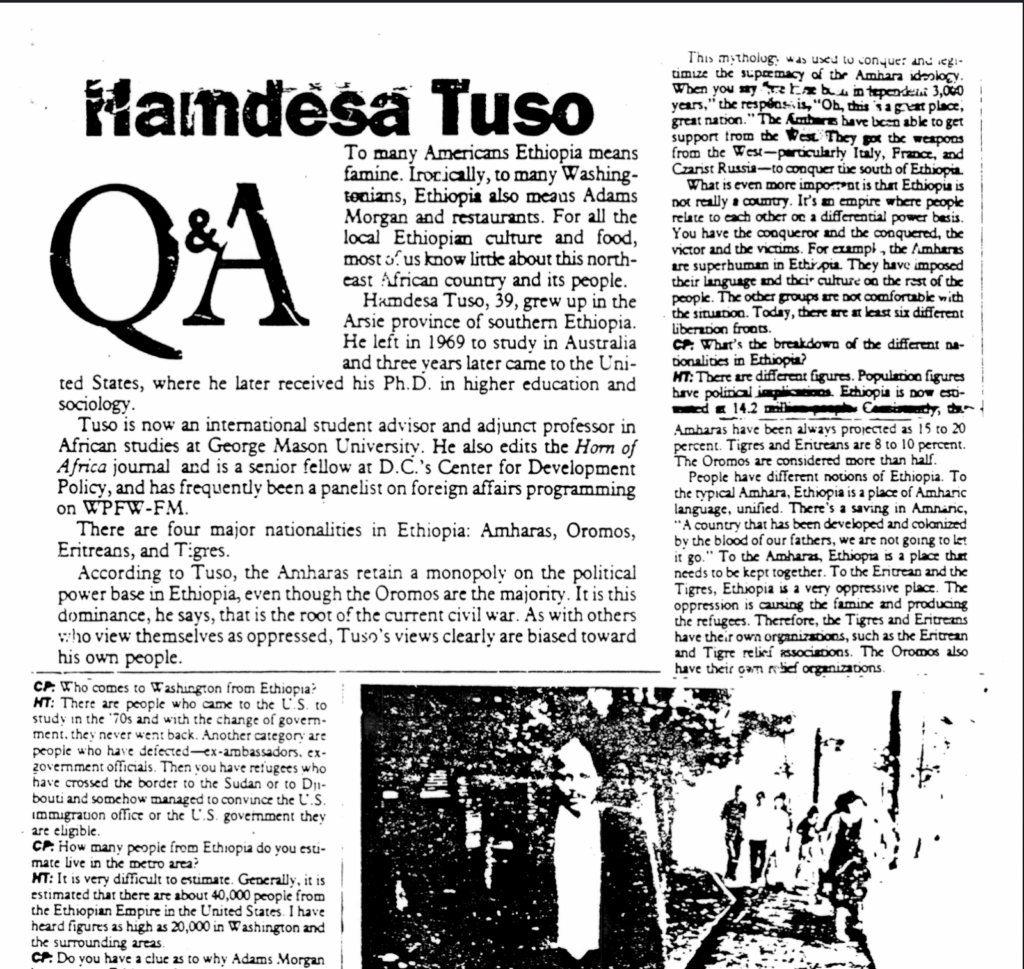
I write as my heart grieves. I write with a heavy heart knowing he is gone. It begins like this: “Seenaa, warm greetings,” as always. He wrote, “I am taking the liberty to forward to you my interview with City Paper in Washington, D.C., which attracted the attention of the State Department.”
He went on to share the story behind that interview with journalist Jon Cohen, who spoke with him about the success stories of Ethiopians in Adams Morgan nearly 40 years ago. The interviewer wanted to highlight Ethiopian success, but Hamedessa skillfully redirected the conversation toward the mythical Ethiopia versus the real Ethiopia. I wasn’t there, but I knew exactly how he could have done it. I spent much of my life doing the same: turning every opportunity into a platform to raise awareness and tell the story of our people.
His Legacy and Contributions
Dr. Hamedessa Tuso earned his Ph.D. at Michigan State University in 1981 and moved to D.C. to advance the Oromo cause. One of his major achievements was organizing the Oromo Committee for Immigration and Refugees (OCIR) so that Oromo could seek political asylum on their own terms. It was historic milestone, marking the new dawn for Oromo identity, though few of us know about it today. He said, At the time, the U.S. government had decided not to grant asylum to anyone from Ethiopia, a political maneuver to pressure the Derg regime to send Cuban forces home. In return, the Derg demanded the U.S. stop granting asylum, in an effort to silence critics abroad.
The “Habesha” community was more organized and formed the Ethiopian Immigration Committee, but Oromo were hesitant to seek help under that umbrella. It was in this context that he formed OCIR and funded from his own pocket with equivalent to over $1,200 today. For Hamedessa, the principle was clear: Oromo, persecuted by the Amhara regime should not seek help under a Habesha organization.
The Habesha community, even though they opposed the Derg regime, fought hard to block the registration of OCIR. But Hamedessa, both as a person of color and a man of principle – persevered. He not only registered the first organization bearing the Oromo name, but also became a powerful voice for justice. It was in this context that his name was recommended to City Paper, leading to the historic 1986 interview. He joked that for us, that sounds like ancient history. “Somehow,” he said, “that interview reached the U.S. State Department,” where he was invited to speak with Ambassador Alan Keyes, then U.S. Ambassador for Human Rights. From that conversation, he introduced the Oromo Liberation Front (OLF) to the State Department—perhaps even to the world. That was where it all began.
Ironically, the Habesha community in Washington, unable to stop him, collected copies of that edition of City Paper and burned them.
Personal Memory
I end my memory of Professor Hamedessa not only for introducing Oromo to Americans, or for his brilliant articulation that read like poetry, or for his endless struggle to free his people from oppression, but also for his insistence that I never call him Professor, Dr., or Obbo. It was hard to call him by his first name, but it was a clear order one I eventually learned to obey.
Final Farewell
I know wishful thinking cannot bring back the past, but I wish more of us truly recognized the depth of this legend’s contribution, especially on the international stage. As someone who has represented the Oromo globally, I can attest to the strength and unwavering dedication it required. I only wish more of us had known him, just a little more, and that we had celebrated him more while he was still with us.
Professor Hamedessa’s contribution to the Oromo struggle was immense. His diplomatic efforts, which introduced the Oromo cause to the world, were beyond our wildest dreams. Today, as we bid farewell, let us remember that Prof. Hamedessa lived and died for his people. He loved his people and devoted every single day to them and them alone.
To my dear adamant friend and advisor, Hamedessa: may you rest in peace. Your voice still echoes in my heart and in the hearts of millions. We will miss you until we meet again. Rest in eternal paradise, Hamedessa.
Call to Action
Share your memories of Professor Hamedessa in the comments below.
Or read more: http://www.hamdesa.com/